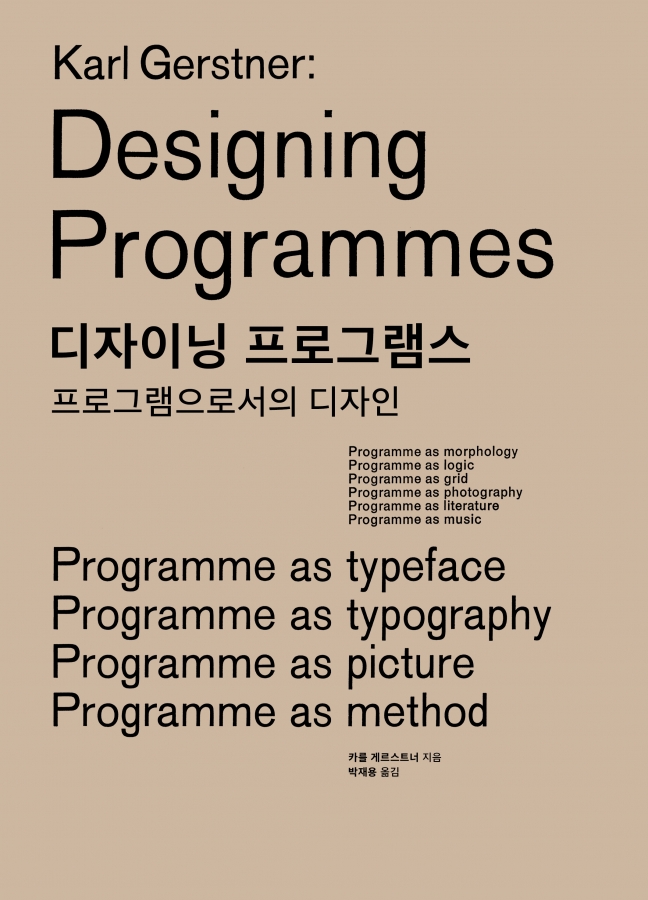
Karl Gerstner (1930–2017) was a leading representative of Swiss typography and one of the most important innovators of typography, advertising graphics and corporate design. From 1945 to 1948, he completed an apprenticeship in Fritz Bühler’s studio and attended courses at the Allgemeine Gewerbeschule Basel, where Armin Hofmann and Emil Ruder were his instructors. In 1949 he followed Max Schmid’s call and joined the legendary design team of Geigy Pharmaceuticals, where he later met the copywriter and editor Markus Kutter. In 1959 they founded the advertising agency Gerstner + Kutter, which was joined by architect Paul Gredinger and in 1963 became GGK (Gerstner Gredinger Kutter), one of Europe’s most successful advertising agencies. Gerstner left the agency in 1970 to focus on his art and on selected design projects. Karl Gerstner had a significant influence on Swiss typography and graphic design. As an artist, he developed a systematic language of colors and forms and pleaded for a correlation between art and everyday life and a functional and aesthetic design of the environment.
Authors
Karl Gerstner
다른 사람들
-
A design journalist, design advisor for grandeclip, and director of C , a magazine focused on iconic chairs. From 2006 to 2022, she worked as a reporter, editor-in-chief, and director at the magazine Monthly Design , overseeing over 200 issues. During this time, she conducted interviews with designers, executives, and marketers from around the world and curated content on projects, exhibitions, spaces, and trends across various design fields. She launched Work Design and authored publications …
-
Oh Seok-hui
Oh Seok-hui is an interdisciplinary engineer exploring metaverses, extended reality, user experience design, generative AI, games, and animation. He is currently a PD at the Cultural Contents Technology Promotion Center of the Korea Creative Content Agency, leading research and development projects and project planning in the field of cultural contents. As a professor of computer science at Gachon University, he has conducted research and development on augmented reality (AR), virtual reality … -
Choi Chul-yong
Choi Chul-Yong studied Textile Art and Fashion Design at Hongik University and its graduate school and later explored the intersection of design and art at the Domus Academy in Milan. After working as a fashion designer and art director for European fashion brands such as Meltin’pot (Italy), Wrangler Blue Bell (Belgium), and Marteli (Italy), he returned to Korea in 2009 and launched his own brand, Cy Choi. Cy Choi has held 18 presentations in Paris, participated in Seoul Fashion Week 10 times, … -
Michel Pastoureau
He is a leading scholar of medieval heraldry and recognized as the first international expert in the field of color. Born in Paris in 1947, he studied at the Sorbonne and the École Nationale des Chartes. He began researching the history of color as an academic subject in 1968 and published his first paper on medieval color in 1977. In 1982, he was appointed Director of Studies in the History and Philology Section at the École Pratique des Hautes Études (EPHE), where he taught for 28 years on … -
Song Myung-min
Studied Visual Design at the College of Design, Sangmyung University, and Communication Design at its Graduate School of Art and Design. Worked as a designer at companies such as Hong Design Co., Ltd., and has taught typography and editorial design courses at Sangmyung University, Hannam University, Kyonggi University, Chungbuk National University, and Pyeongtaek University. Actively engages in creative projects through organizations such as the Korean Society of Typography, the Korean Society … -
Chung Dah-young
Chung Dah-young is a curator at the National Museum of Modern and Contemporary Art, specializing in architecture and design exhibitions and writing. She has curated significant exhibitions, including Diary of Drawings: Chong Ki-yong Architecture Archive (2013), Itami Jun: Sculpting the Wind (2014), Experiments of Architopia (2015), Paper and Concrete: Korean Modern Architecture Movements 1987–1997 (2017), Kim Chung-up: Dialogue (2018), The Olympic Effect: Korean Architecture and Design of the … -
Lim Dae-geun
Im Dae-geun graduated from the Department of Western Painting and the Graduate School of Art Theory at Seoul National University and completed the Ph.D. coursework in Art History at the University of Melbourne. Since 1997, he has been primarily responsible for exhibition planning at the National Museum of Modern and Contemporary Art (MMCA), organizing notable exhibitions such as «Multiple/Dialogues∞» (2009), «Untitled» (2015), «Cracks» (2018), «Park Iso: Records and Recollections» (2018), «MMCA … -
Jeon Jeong-heui
Graduated with a degree in Architectural Engineering from Chungnam National University and earned a master’s degree in Civil and Environmental Engineering from KAIST (Korea Advanced Institute of Science and Technology). After completing the publishing translation program at Geulbab Academy, she now works as a translator with Bareun Translation. -
Han Myoung-sik
Graduated with a degree in Interior Design from the École Municipale des Beaux-Arts Appliqués in Lyon, France, and worked as an interior designer at LG Chem. Currently, teaches and explores architectural spaces with students in the Department of Interior Architecture at Daegu Haany University. -
Seoul Biennale of Architecture and Urbanism
Established in 2017, the Seoul Biennale of Architecture and Urbanism explores the diverse challenges arising from rapid urban growth through the lens of architecture and urbanism. With a focus on Seoul and other global cities, the Biennale seeks to address pressing urban issues and propose innovative solutions. The Biennale features Thematic Exhibitions centered on a specific theme, Guest Cities Exhibition showcasing pioneering public projects from around the globe, and On-site Projects that … -
Sosun Park
With a background in media, theater, and programming development, she uses technology as both material and inspiration for her creative work. As a developer and artist, she creates content that merges technology and art, sharing her work across various social media platforms. Furthermore, she maximizes the unique characteristics of technology and the web as mediums, designing interactive experiences that engage audiences and encourage their participation. -
Lucas Evers
Lucas Evers is Head of the e-Culture Programme at Waag Society. Lucas is involved in projects at the intersection of art, science, design and society, extending the reach of e-Culture to a wider range of technology-informed disciplines.