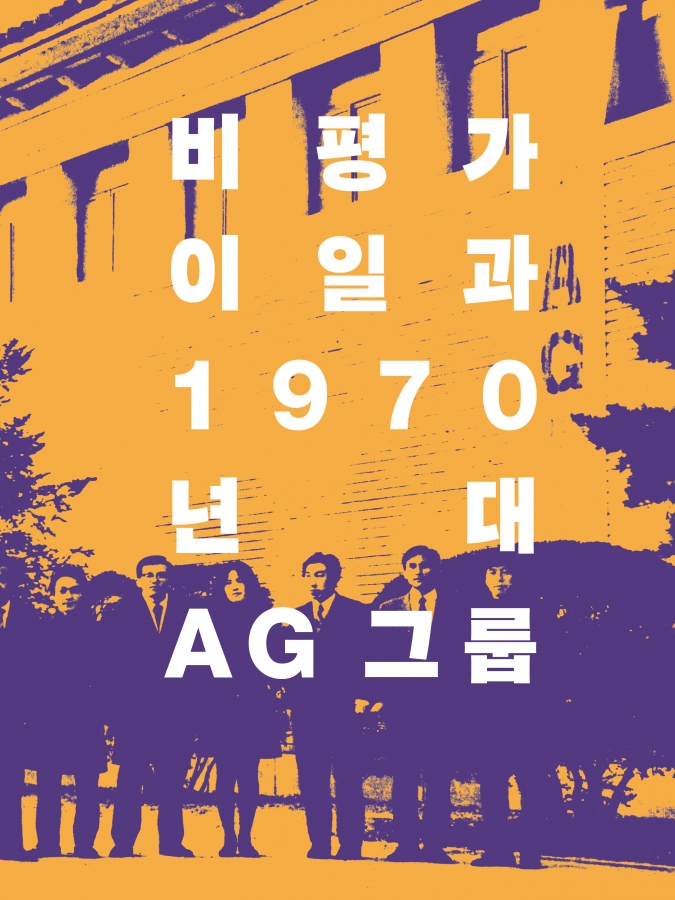
Lee-Yil is an art critic who made a significant contribution to recognizing and establishing the concept of art criticism and review in the Korean art world from the 1960s to the 1990s. Born in 1932 in Gangseo, South Pyongan Province, Lee was a student at Seoul National University, where he was active as a literary youth, organizing the ‘Literature and Literature Society’ and appearing as a poet. After dropping out of college, he studied abroad in France in 1956, where he completed his studies in the history of French literature and art at the Sorbonne University and worked as a Paris correspondent for the Chosun Ilbo. In 1966, he returned to Korea and was appointed as a professor at Hongik University, and in 1968, he was appointed as a dedicated art writer for the Dong-A Ilbo. In 1969, he founded AG as a founding member of the Korean Avant-garde Association, and in 1970, in the preface to the exhibition AG Exhibition he gave a lucid interpretation of Korean contemporary art by proposing the theme of expansion and reduction which was later changed to reduction and diffusion and became a conceptual term representative of Lee-Yil’s art criticism.
He served as an international jury member of the International Printmaking Biennale in Tokyo (1972), Korean commissioner of the Paris Biennale (1975), international jury member of the Cagnes International Painting Festival in France (1977), Korean commissioner of the Venice Biennale (1995), steering committee member and jury member of the Seoul International Printmaking Biennale, Taipei International Printmaking Biennale, and Seoul International Art Festival, and president of the Korean Art Critics Association (1986-1992). He is the author of Trajectory of Contemporary Art (Donghwa Publishing Corporation, 1974), Genealogy of Western Art (API, 1992), Korean Art, Its Present Face (Spatial History, 1982), Perspectives on Contemporary Art (Mijin Book Company, 1985), Return and Diffusion in Contemporary Art (YeolhwaDang, 1991), The Adventure of Abstract Art (by Michel Lagong, Culture and Education Publishing House, 1965), The Birth of New Art (by Michel Lagong, Jeongneumsa, 1974), History of World Painting (by Louis Urtig, Joongang Ilbo Publishing House, 1974), History of Western Art (by H. W. Janson, Mijinsha, 1985). In 1986, he participated in the founding of the magazine Art Criticism (published by the Korean Art Critics Association), and in 1990, he was awarded the Order of Culture by the French Ministry of Culture. He passed away in January 1997, and was honored with the Order of the Archival Culture in 1999 and the Special Achievement Award of the International Art Critics Association (AICA) in 2014.
Authors
Lee Yil
이일
다른 사람들
-
She studied journalism at Yonsei University and worked in marketing and public relations in the corporate world. While pursuing her master’s program in arts management at Carnegie Mellon University, she worked for the public art team at Pittsburgh City Hall and later worked as a design strategy manager in the corporate world. She is a graduate of the Gulbab Academy and currently works as a translator for BarTranslation.
-
Chang Eung-bok
Born in Seoul, Chang Eung-bok graduated from the College of Fine Arts at Hongik University and founded Mono, the predecessor of Mono Collection, in 1985. With a foundation in textile design, she has contributed significantly to Korea’s textile design industry, working across residential and commercial spaces, domestic and international hotel projects, and furniture and soft interior design. She has held numerous exhibitions, including at Mori Art Museum (2005), Gallery Artlink (2010), Seoul … -
Yonsei HCI Lab
The Yonsei HCI Lab focuses on research in human-AI interaction, with a special emphasis on UX design for digital health systems that enhance well-being and treat diseases. The lab members, who are not just HCI experts but ‘Experience Engineers,’ are dedicated to developing innovative digital health products that help bring meaningful experiences through AI technology. -
Fernando Pessoa
Born in 1888 in Lisbon, Portugal, and raised in Durban, South Africa. At the age of 17, he returned to Lisbon, where he worked as a translator for a trading company. He passed away in 1935, but after his death, a “trunk” found in his room contained an extensive collection of prose and poetry manuscripts, which were later published to great acclaim. Widely known for his exploration of multiple selves through writing under numerous heteronyms, his work has had a profound impact on … -
Kuma Kengo
Born in Yokohama in 1954, he studied architecture at the University of Tokyo and was a visiting scholar at Columbia University’s Department of Architecture and Urban Planning in the United States. He is currently a principal of Kengo Kuma and Associates and a special professor and professor emeritus at the University of Tokyo. His major works include Kiro-San observatory (1994), Water/Glass, Atami, Noh Stage in the Forest /Moributai Traditional Performing Arts Museum, Bato Hiroshige … -
Fukasawa Naoto
Naoto Fukasawa was born in 1956 in Yamanashi, Japan. He graduated from Tama Art University in 1980 and began his career at Seiko Epson, where he worked on advanced designs for watches and other micro-electronic devices. In 1989, he joined ID Two, a San Francisco-based product design firm that later became IDEO. In 1996, Fukasawa returned to Japan to establish and oversee IDEO’s Tokyo office. In 2003, he founded Naoto Fukasawa Design . Since 2001, he has served as a design advisor for MUJI … -
Choi Dae-suk
Graduated with a BFA from the College of Fine Arts at Hongik University, an MFA in Industrial Design from Seoul National University, and an MBA in Marketing from Yonsei University. Guided by the belief that “a successful designer must balance theory (文) and practice (武),” he is dedicated to professional design education while contributing to the field as a recommended designer and jury member for the Korea Industrial Design Exhibition. His primary interests include new product … -
Kim Nan-Ju
Graduated from Kyung Hee University’s Department of Korean Language and Literature, and received a master’s degree in modern Japanese literature from Showa Women’s University in Japan. Currently working as a translator specializing in Japanese literature. Books she has translated include Between Coolness and Passion: Rosso , Kitchen , The Doctor’s Beloved Formulas , The Tale of Genji , I Am a Cat , Voyage Through Stars , The Newcomer , etc. -
김동환
연세대학교 커뮤니케이션대학원 HCI디자인 전공 교수이자 디자인 & 인텔리전스 연구실 디렉터. LG전자 MC사업부 UX 디자이너와 뉴욕 와이어리스 제너레이션 프로덕트 디자이너로 일했고, 인간과 알고리즘의 협업을 연구한 Lab64를 설립·운영했다. 롱아일랜드대학교에서 컴퓨터 과학을 공부했고, 카네기멜론대학교에서 HCI 석사 학위를, 서울대학교에서 언론정보학 박사 학위를 취득했다. 기술이 인간의 고유한 창의성을 무한히 확장시키는 즐거운 도구가 될 것으로 믿고, 디자이너가 여러 AI 에이전트와 호흡을 맞추며 단순한 작업자를 넘어 ‘창의적 지휘자’로 거듭나는 방법을 연구한다. “AI가 나를 대체할까?”라는 막연한 두려움이 “AI와 함께 무엇을 더 할 수 있을까?”라는 설렘으로 변하기를 바란다. -
Kim Hyun-mi
She studied graphic design at Seoul National University and Rhode Island School of Design, USA. She started working at the advertising agency Oricom and worked on many identity design projects as a freelancer. She is currently a professor of communication design at Samsung Advanced Design Institute (SADI). She is the author of The New Typographic Revolutionary: Jan Tschichold , 33 Typeface Stories that Make Good Design , and Ode to Typography , as well as independently published artist books, … -
Ogawa Naho
Ogawa Naho is a unique and whimsical sensibility who draws with elegant and delicate lines and brings her own playfulness to her paintings. She studied at Parsons School of Design in New York City, which gives her drawings a distinctly New York style. She has traveled and worked with luxury brands, fashion magazines, and famous department stores in the world’s biggest cities, including Anna Sui, Vogue , Elle , Newsweek , Wall Street Journal , The New Yorker , Ja Cosmetics , Hong Kong … -
Kiura Mikio
Born and raised in Osaka. He has two master degrees in computer science at Nara Institute of Science and Technology and design at Copenhagen Institute of Interaction Design. Currently, he runs his award-winning design studio ANKR DESIGN in Tokyo and designs new products and services with his clients. He thoroughly understands the Japanese manufacturing industry, as well as, the workflow of large companies and startups in Japan. He also has a profound knowledge of Japan’s unique culture and …