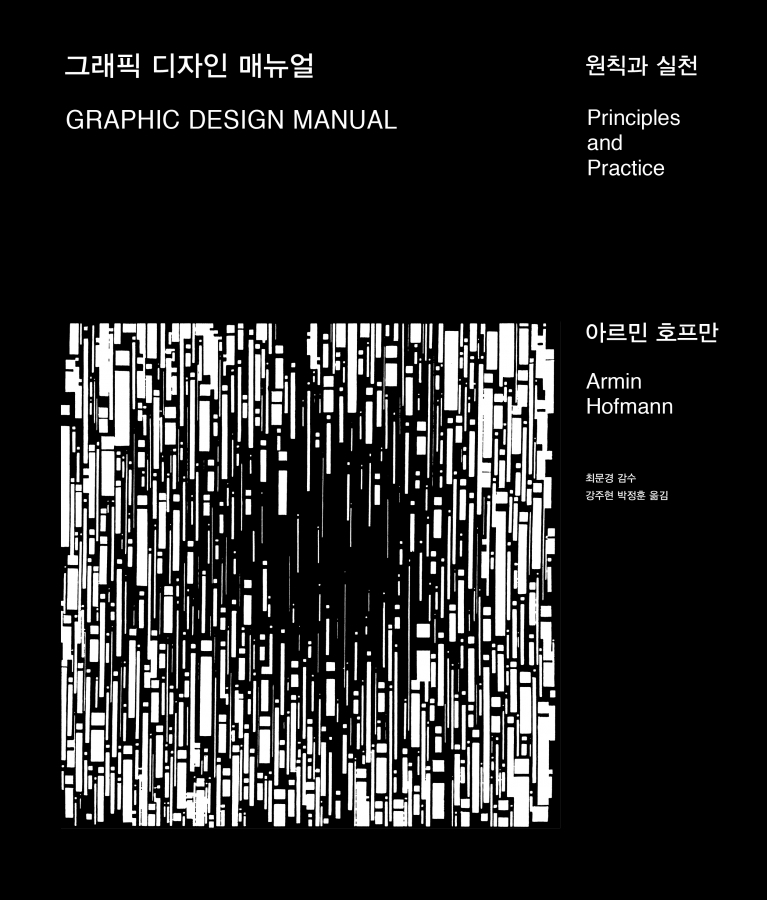
Armin Hofmann was a Swiss graphic designer. He was one of the most prominent individuals in Swiss design. He began his career in 1947 as a teacher at the Allgemeine Gewerbeschule Basel School of Art and Crafts at the age of twenty-six. Hofmann followed Emil Ruder as head of the graphic design department at the Schule für Gestaltung Basel (Basel School of Design) and was instrumental in developing the graphic design style known as the Swiss Style. His teaching methods were unorthodox and broad based, setting new standards that became widely known in design education institutions throughout the world. His independent insights as an educator, married with his rich and innovative powers of visual expression, created a body of work enormously varied – books, exhibitions, stage sets, logotypes, symbols, typography, posters, sign systems, and environmental graphics. His work is recognized for its reliance on the fundamental elements of graphic form – point, line, and shape – while subtly conveying simplicity, complexity, representation, and abstraction. Originating in Russia, Germany and The Netherlands in the 1920s, stimulated by the artistic avant-garde and alongside the International Style in architecture. He is well known for his posters, which emphasized economical use of colour and fonts, in reaction to what Hofmann regarded as the “trivialization of colour.” His posters have been widely exhibited as works of art in major galleries, such as the New York Museum of Modern Art. He was also an influential educator, retiring in 1987. In 1965 he wrote the Graphic Design Manual, a popular textbook in the field.
Authors
Armin Hofmann
다른 사람들
-
Graphic designer at Toss. Plans and creates all visual aspects of Toss. She focuses on the visual consistency of Toss graphics by establishing and spreading a visual identity based on the emoji font “Toss Face”.
-
Choi Jin-young
Observes daily life and translates memorable scenes and stories into illustrations. Aspiring to convey the joy and vitality of drawing, contributes artwork across various media. Illustrated books include: Children’s University: Physics , Accidental Design , The More Different, the Better , Words on the Road . -
Kim Jae-hong
He graduated from Central St. Martins College Art & Design, UK, and has been active in VIDAK, the Korean Society Of Basic Design & Art, and the Korea package Design Association. He is currently a professor of art and visual design at Chungbuk National University, College of Humanities. He has co-authored the books Design Education and Slow Food . -
Hansil
Awakened to the disarray in the Korean language, he dedicated himself to reviving dying words, simplifying difficult Sino-Korean terms into accessible native expressions, and interpreting Korean words in Korean. He established “Maum-Dakkeuneun Maeul” (Mind-Polishing Village) at the foot of Surime (Mount Songni) in the Sabara region (Sangju) of Nosarasa (Gyeongbuk). There, he leads meditation practices to help anyone polish their mind, freeing themselves from suffering to live a … -
Ando Tadao
Born 1941 in Osaka, Japan. Self-taught in architecture. Established Tadao Ando Architect & Associates in 1969. Major works include the Church of the Light, Pulitzer Arts Foundation, and Chichu Art Museum. Awarded the Architectural Institute of Japan (AIJ) Prize for the Row House in Sumiyoshi in 1979, Japan Art Academy Prize in 1993, Pritzker Architecture Prize in 1995, Person of Cultural Merit (Japan) in 2003, International Union of ArchitectsUIA Medal in 2005, John F. Kennedy Center Gold … -
Lee Hyun-kyung
Starting her journey in design in the Department of Visual Communication Design at Hongik University, she worked as a GUI designer at LG Electronics’ Design Management Center. She pursued Museum Studies at Syracuse University in New York and gained practical experience as an intern at the National Museum of Modern and Contemporary Art in Korea and the Orange County Museum of Art in the United States. She earned her Ph.D. in Arts Administration from Florida State University. She honed her skills … -
Korean Society of Typography
The Korean Society of Typography (hereafter KST) is an academic organization in South Korea, started in 2009. The KST supports many design activities to diversify the visual communication field. Some of which include the journal LetterSeed , academic conferences, annual exhibitions as well special committees on Korean typography, typographic terminology, digital typography education, international typography biennale, and a diverse range of research. -
Oh Byung-keun
His teaching and research focuses on visualization for information and knowledge transfer. He is also interested in design-centered and interdisciplinary approaches for desirable interactions between humans and information, humans and media, and humans and space. He received his B.A. and Ph.D. in design from Seoul National University and his M.F.A. from New York University Graduate Center, and is currently a professor of visual design at Yonsei University, College of Design and Art. His books … -
Omagari Toshi
Toshi Omagari is a font designer at Monotype in the UK. He studied typography and font design at Musashino Art University in Tokyo, graduating in 2008. Arcade Game Typography is his first book. -
Lee sang-hoon
He graduated with honors from Hongik University, College of Fine Arts. He received his master’s degree in contextual design from Design Academy Eindhoven, the Netherlands, and his doctorate in educational psychology from Korea University. He was selected as a Korean Next Generation Design Leader by the Ministry of Trade, Industry and Energy and is currently a professor at the Department of Design Convergence, College of Architecture, Hongik University. -
Park Hyun-taek
Majored in visual design at Hongik University and lectured at several universities before coming across the National Museum of Korea, where work has continued for over twenty years. While working in the fields of ‘museums,’ ‘design,’ and ‘culture,’ doubts arose about the fact that design was being absorbed only in external decoration. Reevaluating design led to confronting the question of ‘why and for whom to design,’ rather than ‘how to design.’ This process led to the realization that design … -
Hyundai Motor Company
Hyundai Motor Company is a global leader in the automotive industry that exports vehicles to over 200 countries and has established production facilities worldwide. As the pioneer of Korea’s automotive industry, Hyundai made history with the development of the nation’s first independently designed model, the Pony. The company has continued its legacy of innovation via the introduction of the world’s first mass-produced hydrogen fuel cell vehicle, XCIENT Fuel Cell, and the expansion its …