He is the abbot of Dokuozan Genko-ji Temple of the Soto School, a garden designer, and a professor in the Department of Environmental Design at Tama Art University. Born in 1953, he graduated from the Department of Agriculture in the College of Agriculture at Tamagawa University in Japan and practiced at the head temple Sojiji. While creating Zen gardens, he has given lectures at schools and museums around the world.
As a garden designer, he has received numerous honors, including the Art Encouragement Prize for New Artists from the Minister of Education, Culture, Sports, Science and Technology, the Foreign Minister’s Commendation, the Governor General’s Award of Canada, and the Order of Merit of the Federal Republic of Germany. In 2006, he was selected by the Japanese edition of Newsweek as one of the “100 Japanese the World Respects.”
His major works include the garden at the Embassy of Canada in Japan, the Cerulean Tower Tokyu Hotel garden, the garden of the Faculty of Medicine at the University of Bergen in Norway, and the garden at Hotel Le Port Gojimachi. His published books include The Monk’s Cleaning Method, Understanding Japanese Gardens, The Zen Garden, Muso Soseki, As It Is, A Recommendation of a Simple Lifestyle, and Zen: The Art of Simple Thinking, among others.
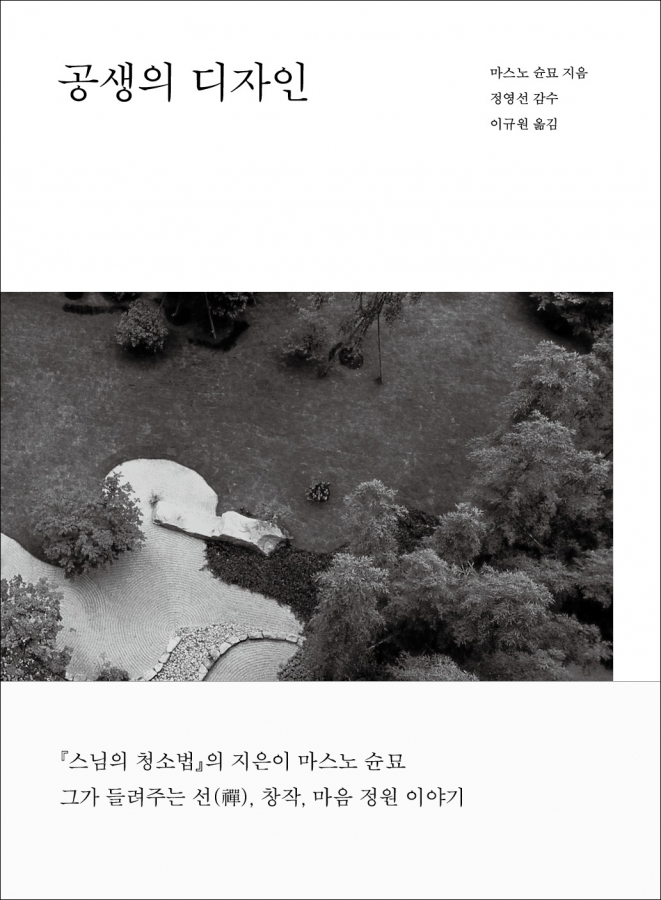
Authors
Shunmyo Masuno
枡野俊明
다른 사람들
-
Editorial director of VOSTOK magazine and head of VOSTOK PRESS. He is the editor of various publications and the director of PLATFORM-P. He has worked as the chief editor of the design journal Yanggwibi , editor-in-chief of the Seoul National University Press and Culture Center, and a member of the planning committee of the School of Photographic Theory and the bimonthly magazine Wordnbow , and received the Art in Culture New Vision Art Criticism Award.
-
Pureun Nuri
People who believe that if everything we discard and throw away becomes compost, we can live in harmony with the earth, keeping our living spaces clean and sharing the green bounty of the planet with all living beings. They dedicate their lives to farming during the summer, cultivating not just crops but a sustainable way of life. -
Lim Taehee
After completing a research program in Architecture at Kyoto University, he returned to South Korea and gained six years of practical experience in the field. He later went back to Japan and earned a Ph.D. in Architecture from Kyoto Institute of Technology. Currently, he runs Im Taehee Design Studio, continuing to work on various projects. -
Kashiwagi Hiroshi
Design critic. Professor Emeritus at Musashino Art University and Honorary Fellow at the Royal College of Art. Born in Kobe in 1946. Graduated from Musashino Art University. After working as an editor, became an associate professor at Tokyo Zōkei University in 1983. Started at his current position in 1996. His works include Design no 20 seiki (The 20th Century of Design) (NHK Shuppan, 1992), Housework no seiji gaku (The Politics of Housework) (Seidosha, 1995), and Nichijitsu no bunka shi (The … -
Lee Kyu-chul
Lee Kyu-chul (1948-1994, Incheon) graduated from Hongik University in 1974, majoring in sculpture. In 1975, he left for Saudi Arabia, where he worked as an administrator and videographer for the Vinnell Company in the United States. In 1983, he entered graduate school at the Massachusetts College of Art and Design, but returned home after three semesters. He had his first solo exhibition, Space and Visual Perception (Kwanhoon Museum of Art, 1988), which he spent time researching alone, and … -
Joachim Müller-Lancé
He graduated with honors from the Basel School of Design in Switzerland and studied art at the Cooper Union in New York, USA. He worked as a senior designer for The Understanding Business and Barclays Global Investors, and organized cultural exhibitions and publications for the 1992 Olympic Games in Barcelona. In 1993, he won a gold medal at the Morisawa Typeface Competition in Lancecerro. He is currently the head of Kame Design Studio, where he focuses on graphic design, type design, and … -
Lee Kyu-bok
He majored in calligraphy at Wonkwang University and completed his doctoral program at Dongguk University. In 2002, he founded CalliDesign, a company specializing in calligraphy, where he is currently the president, and served as a board member of the Korea Calligraphy and Design Association. He has been in charge of important large-scale projects in Korea, including the slogan titles for the 17th and 18th presidential inaugurations, the slogan titles for the opening of Gwanghwamun Square, the … -
Lee Kyu-won
She majored in Japanese at Hankuk University of Foreign Studies. She has worked as an editor for many years, organizing books in various fields including science, humanities, and history. She is currently working as a professional translator. He has translated Miyuki Miyabe’s Reason , Seicho Matsumoto’s Masterpiece Short Story Collection , Alaska, A Story Like the Wind , Tadao Ando’s I, Architect , and more than 80 other books. -
Farah Kafei
Farah Kafei is a designer and art director who has led initiatives addressing gender disparity in design education and fostered communities pushing for a more inclusive industry. She’s had the pleasure of working for the Metropolitan Museum of Art and studios such as Sagmeister & Walsh and Doubleday & Cartwright. -
Kwak Yung-bin
He is an art critic and visiting professor at Yonsei University’s Graduate School of Communication, and holds a PhD from the University of Iowa, USA, with a “The origin of Korean Trauerspiel”. In 2015, he was awarded the inaugural SeMA-Hana Art Criticism Award, the first national art criticism award established by the Seoul Museum of Art (SeMA). His recent publications include “The Blind Past and the Eternal Return of Global Civil War: Difference and Repetition in Omer Fasth … -
Jakob Schneider
Jakob Schneider is partner and creative director at KD1 design agency, co-founder of More than Metrics and Smaply, designer and editor of This is Service Design Doing and This is Service Design Thinking. -
Akasegawa Genpei
Akasegawa Genpei was a pseudonym of Japanese artist Akasegawa Katsuhiko (赤瀬川克彦), born March 27, 1937 in Yokohama. He used another pseudonym, Otsuji Katsuhiko (尾辻克彦), for literary works. A member of the influential artist groups Neo-Dada Organizers and Hi-Red Center, Akasegawa went on to maintain a multi-disciplinary practice throughout his career as an individual artist. In 1986, Akasegawa and his collaborators, Terunobu Fujimori and Shinbo Minami, to announce the formation of a new group: …